
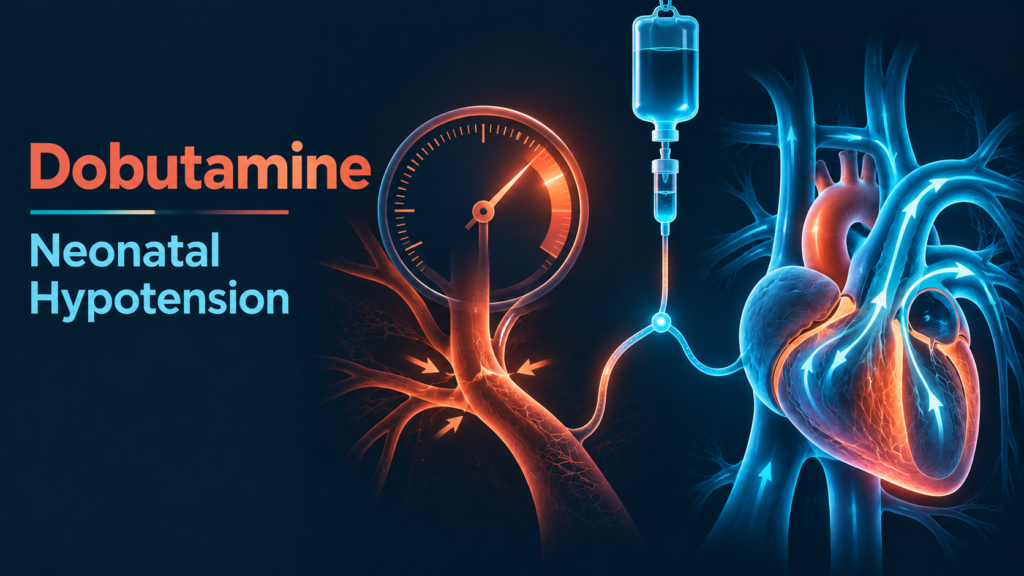
Dobutamine treats the pump, not the pressure gauge. It’s the inotrope for the newborn whose problem is poor contractility and high afterload — where raising cardiac output matters more than the number on the monitor.
Reach for dobutamine when the lesion is myocardial dysfunction or high afterload, not simple vasodilatation. It reliably improves systemic blood flow but often won’t lift blood pressure — so judge it by cardiac output on echo, not by the mean arterial pressure alone.
01 How it works
Dobutamine is a synthetic catecholamine that acts directly and predominantly on myocardial β1 receptors, increasing contractility and stroke volume in a dose-dependent way.6,4 It is a racemic mixture: the (+) enantiomer is the β-agonist, while the (−) enantiomer carries the α1 activity.5
In the periphery its β2-mediated vasodilatation and α1-mediated vasoconstriction largely offset one another, so it has little net effect on systemic vascular resistance and afterload.8
Unlike dopamine — which acts partly by releasing stored noradrenaline — dobutamine stimulates receptors directly. In the preterm heart, with its depleted noradrenaline stores, this direct action is a theoretical advantage (mechanistic).4
02 Pressure vs flow — the real trade-off
Dobutamine and dopamine embody opposing philosophies: treat the blood pressure, or treat the blood flow.
- StrengthSuperior at improving systemic blood flow and left-ventricular output4
- EvidenceIn a randomised trial in preterm infants with low systemic flow, dobutamine produced a significantly greater rise in SVC flow than dopamine1,7
- BedsideIts benefit (higher cardiac output) is only visible on targeted echo (TnECHO)
03 Where dobutamine is the right call
Choose by the physiology — dobutamine suits states where pump failure or high afterload dominates (pathophysiology-guided consensus).
Post-PDA-ligation cardiac syndrome
Ligation loads the non-compliant preterm left ventricle with a sudden rise in afterload, often causing LV dysfunction 6–12 h later. An echo-guided inodilator (dobutamine or milrinone) supports LV performance and lowers afterload (expert consensus).5
Cold septic shock
Low cardiac output with high SVR and vasoconstriction — dobutamine relieves the intense afterload and supports contractility rather than tightening the circulation further (expert consensus).
PPHN with ventricular dysfunction
A logical first choice where the right ventricle is failing: it supports contractility without directly constricting the pulmonary bed, helping the pulmonary-to-systemic resistance balance (mechanistic/consensus).
04 Pitfalls, and the one absolute contraindication
References
- Osborn D, Evans N, Kluckow M. Randomized trial of dobutamine versus dopamine in preterm infants with low systemic blood flow. J Pediatr. 2002;140(2):183–191. doi.org/10.1067/mpd.2002.120834
- Sassano-Higgins S, Friedlich P, Seri I. A meta-analysis of dopamine use in hypotensive preterm infants: blood pressure and cerebral hemodynamics. J Perinatol. 2011;31(10):647–655. doi.org/10.1038/jp.2011.2
- Sarafidis K, Verykouki E, Nikopoulos S, et al. Systematic review and meta-analysis of cardiovascular medications in neonatal hypotension. Biomed Hub. 2022;7(2):70–79. doi.org/10.1159/000525133
- Pacifici GM. Clinical pharmacology of dobutamine and dopamine in preterm neonates. Med Express. 2014;1(5):250–259. doi.org/10.5935/medicalexpress.2014.05.12
- Pacifici GM. Clinical pharmacology of dobutamine in infants and children. Clin Res Notes. 2022;3(2):1–5. doi.org/10.31579/2690-8816/049
- Brew N, Nakamura S, Hale N, et al. Dobutamine treatment reduces inflammation in the preterm fetal sheep brain exposed to acute hypoxia. Pediatr Res. 2018;84(3):442–450. doi.org/10.1038/s41390-018-0045-5
- Eiby YA, Shrimpton NY, Wright IMR, et al. Inotropes do not increase cardiac output or cerebral blood flow in preterm piglets. Pediatr Res. 2016;80(6):870–879. doi.org/10.1038/pr.2016.156
- Sanchez-Holgado M, Alvarez-Garcia P, Bravo MC, et al. Dose-finding for dobutamine during transitional circulation in the very preterm infant: study protocol. PLoS One. 2025;20(12):e0338307. doi.org/10.1371/journal.pone.0338307
Educational summary for clinicians and trainees. Referenced to primary sources; items marked mechanistic, expert consensus or trend/consensus reflect reasoning or practice rather than trial evidence. Doses are for orientation only — always follow your unit’s formulary and senior review. This supports, and does not replace, local guidelines and individualised clinical judgement.