
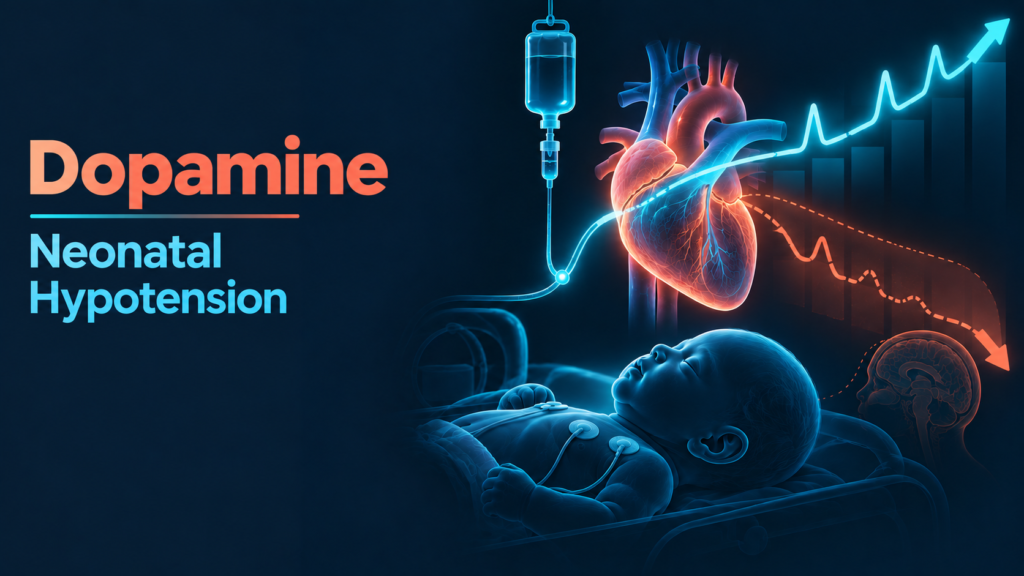
The default inotrope of the NICU — reliable at lifting the number on the monitor, and quietly limited beneath it. Dopamine reliably raises blood pressure, but four decades on there is still no proof it makes babies do better.
Dopamine is entrenched because it raises blood pressure reliably and is easy to titrate at the bedside — not because it improves outcomes. In the preterm infant its indirect mechanism, endocrine effects and lack of proven benefit are real limitations worth weighing against habit.
01 Why it dominates the bedside
Clinical algorithms are built around a standardised “volume, then dopamine” sequence, and dopamine is by far the most-studied and most-used neonatal vasoactive agent.2,7 In a cross-sectional survey of 320 Indian neonatal physicians, for sepsis-related hypotension dopamine was the most preferred first-line agent, ahead of norepinephrine, low-dose epinephrine and dobutamine.1
Its appeal is practical: rapid onset, universal availability, and — crucially — its main measure of success, a higher blood pressure, is continuously visible on the monitor.3
02 How it works — a dose ladder
Dopamine is an endogenous catecholamine and the precursor of noradrenaline, acting across several receptor families in a dose-dependent way.2,3
03 The catch in the preterm infant
Efficacy at raising a number doesn’t mean it’s doing good — several physiological costs matter most in the extremely preterm.
Because the inotropic effect leans on releasing stored noradrenaline, and preterm stores are scant, efficacy fades — dopamine is a poor long-term inotrope.2
At >10 µg/kg/min the intense vasoconstriction loads the immature ventricle; with a PDA it can shift the systemic-to-pulmonary pressure ratio and promote right-to-left shunting, worsening tissue hypoxia.2
Dopamine suppresses the pituitary, causing a reversible fall in TSH, thyroxine (T4) and prolactin; levels rebound once it’s stopped, and the long-term significance is unresolved.6
Clearance is highly gestation-dependent and can be markedly reduced in sick, very preterm infants, risking accumulation.2
04 The evidence gap that never closed
Dopamine is significantly more effective than dobutamine at raising blood pressure in the short term.4,5 But that is where the evidence stops:
References
- Das R, Nagpal R, Deshpande S, et al. A survey on management practices of hypotension in preterm neonates: an Indian perspective. Front Pediatr. 2024;12:1411719. doi.org/10.3389/fped.2024.1411719
- Joynt C, Cheung PY. Treating hypotension in preterm neonates with vasoactive medications. Front Pediatr. 2018;6:86. doi.org/10.3389/fped.2018.00086
- Agakidou E, Chatziioannidis I, Kontou A, et al. An update on pharmacologic management of neonatal hypotension: when, why, and which medication. Children. 2024;11(4):490. doi.org/10.3390/children11040490
- Sassano-Higgins S, Friedlich P, Seri I. A meta-analysis of dopamine use in hypotensive preterm infants: blood pressure and cerebral hemodynamics. J Perinatol. 2011;31(10):647–655. doi.org/10.1038/jp.2011.2
- Sarafidis K, Verykouki E, Nikopoulos S, et al. Systematic review and meta-analysis of cardiovascular medications in neonatal hypotension. Biomed Hub. 2022;7(2):70–79. doi.org/10.1159/000525133
- Filippi L, Pezzati M, Poggi C, et al. Dopamine versus dobutamine in very low birthweight infants: endocrine effects. Arch Dis Child Fetal Neonatal Ed. 2007;92(5):F367–F371. doi.org/10.1136/adc.2006.098566
- Pazandak C, McPherson C, Abubakar M, et al. Blood pressure profiles in infants with HIE, response to dopamine, and association with brain injury. Front Pediatr. 2020;8:512. doi.org/10.3389/fped.2020.00512
- Osborn DA, Evans N. Early volume expansion versus inotrope for prevention of morbidity and mortality in very preterm infants. Cochrane Database Syst Rev. 2001;(2):CD002056. doi.org/10.1002/14651858.CD002056
Educational summary for clinicians and trainees. Referenced to primary sources; items marked mechanistic or expert consensus reflect reasoning or practice rather than trial evidence. Doses are for orientation only — always follow your unit’s formulary and senior review. This supports, and does not replace, local guidelines and individualised clinical judgement.