
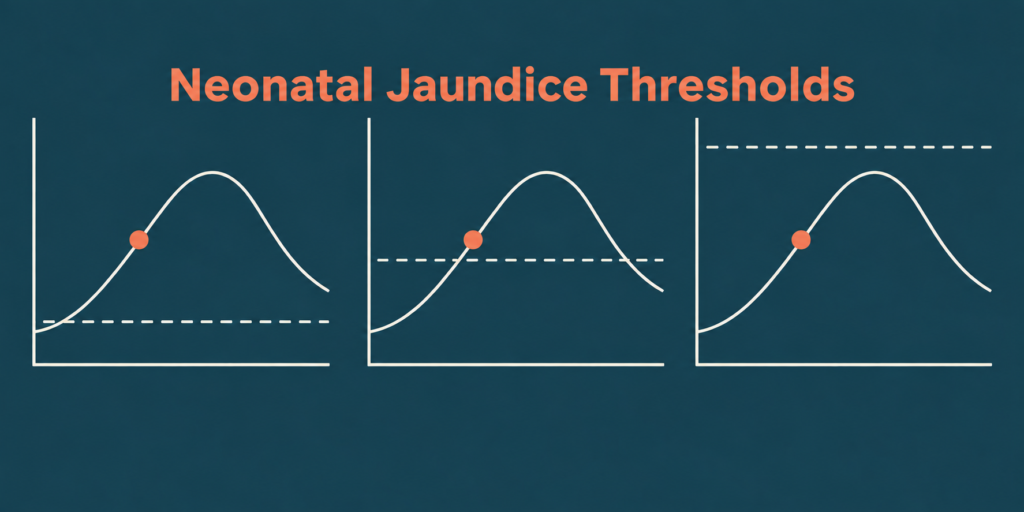
Three hundred and forty-four babies, all born at 35 weeks or more, all admitted for indirect hyperbilirubinaemia. Researchers took each one and asked a simple question: was this admission justified? Then they asked it twice — once against their national guideline, once against the 2022 AAP guideline.
Under the national thresholds, 89.2% of those admissions were appropriate. Under the AAP, only 36.6% met admission criteria.[1]
Same babies. Same bilirubin values. Same day. Roughly two-thirds of them reclassified by nothing more than which document the unit had chosen.
Why this matters
Most of us learned jaundice management from one guideline and then carried it somewhere else. Trainees move between systems. Consultants move between countries. Units across the Gulf, South-East Asia, the Middle East and Africa adopt an American or British guideline wholesale, and the copy on the wall outlives the person who chose it.
The condition being managed is almost always benign and occasionally catastrophic. In the UK and Ireland surveillance study, severe hyperbilirubinaemia ran at about 7.1 per 100,000 live births and bilirubin encephalopathy at 0.9 per 100,000; of 108 affected babies, only 20 presented while still in hospital and 88 were admitted from home.[2] A Taiwanese population study over 2000–2010 put kernicterus at 0.86 per 100,000 live births.[3] Rare, irreversible, and increasingly a community problem rather than a ward one.
The guidelines all point at the same target. What they disagree about is how to build a service around it — and the disagreement is larger, and better documented, than most of us realise.
The variation is measured, not anecdotal
Zhang and colleagues appraised 12 clinical practice guidelines for neonatal hyperbilirubinaemia using AGREE-II, the standard instrument for judging guideline quality. Scores ranged from 36% to 89%.[4]
The pattern within those scores is the interesting part. Guidelines scored highest on clarity of presentation and lowest on rigour of development. Our guidance on this condition is, on average, better written than it is built.
The review also found that recommendations for diagnosis were relatively consistent across guidelines. What varied was risk factors, the threshold for initiating treatment, and pharmacotherapy.[4]
That is the shape of the whole problem. Nobody disagrees about what bilirubin does to a brain. The disagreement is about strategy.
The first fault line: do you measure every baby?
The AAP recommends universal screening — a transcutaneous or serum bilirubin in every newborn, between 24 and 48 hours of age, or before discharge if that comes sooner.[5]
The CPS also screens universally, but specifies it differently: a pre-discharge total serum or transcutaneous bilirubin in all newborns at a minimum of 12 hours post-birth, within a window of 12 to 120 hours.[6]
NICE says the opposite, and says it as an explicit negative recommendation. CG98, recommendation 1.2.7: “Do not measure bilirubin levels routinely in babies who are not visibly jaundiced.”[7]
The UK system runs on structured looking backed by a clock. Examine every baby — sclerae, gums, blanched skin, in good light. When jaundice is seen, measure urgently: a serum bilirubin within 2 hours if the jaundice appears in the first 24 hours of life, and within 6 hours thereafter.[7]
It would be easy to read the British position as a guideline that has fallen behind. It isn’t. NICE reviewed the question again in 2023 through exceptional surveillance and concluded there was insufficient new evidence to change its recommendations on risk factors, or on the diagnostic accuracy of assessment approaches in babies with darker skin tones. The only update triggered concerned serum bilirubin thresholds, on the grounds of variability between laboratory assays.[7] CG98 was last updated in October 2023 and has not been updated since.[7]
Two competent national bodies, examining broadly the same evidence, reaching opposite conclusions about the same question.
And here is the finding that should temper confident teaching on either side: no retrieved study compares universal screening against targeted screening for neurodevelopmental outcomes or kernicterus. We searched for it specifically. It is not there. Anyone who tells you their country’s screening strategy is proven is asserting something the published evidence does not support.
The second fault line: how a number becomes a decision
Suppose you have measured a bilirubin. What turns that number into an action?
This is where the three guidelines are doing genuinely different intellectual work — not different numbers, different methods — and it is the part that rarely gets taught explicitly.
Britain hands you a line and a number
NICE provides treatment threshold graphs by gestational age. Plot the baby, read across, get a line. And NICE gives absolute values you can commit to memory: for a baby 38 weeks or more, at 72 hours and beyond, the phototherapy threshold is >300 µmol/L and the exchange threshold >450 µmol/L.[7]
Gestation moves the line. But as the comparative literature characterises the British approach, it does not explicitly build neurotoxicity risk stratification into the threshold itself.[1] A septic baby and a well baby at the same gestation and postnatal age read off the same line, and clinical judgement — rather than the chart — handles the difference.
America hands you a distance from a line
The AAP does not want you thinking in absolute numbers at all. It wants you thinking about a gap.
The threshold is hour-specific, gestation-specific, and shifts according to whether the infant has neurotoxicity risk factors, with separate curves for that. Almost every downstream decision is then expressed as a distance from that line rather than as a value: stop phototherapy 2 mg/dL below it, escalate 2 mg/dL below the exchange line, set the follow-up interval by how far below threshold the baby sits at discharge.[5]
That is a real conceptual shift, and arguably the most important export of the 2022 revision. The question stops being “is this bilirubin high?” and becomes “how much room does this particular baby have left?”
Canada takes the American method and compresses it
The Canadian Paediatric Society replaced its 2007 document with a new statement — posted March 2025 with a December 2025 addendum, and published in the journal this year.[6] It is the most consequential recent development in this space and has attracted surprisingly little attention.
Canada did not pick a side. It adopted the American method — the CPS defines ΔTSB as the age-in-hours-specific phototherapy threshold minus the measured TSB or TcB[6] — and rebuilt it in micromoles per litre, with separate threshold graphs for infants with and without neurotoxicity risk factors, by gestational age from 35 to 40 weeks.[6]
Then it did something the AAP did not. It compressed the practical consequences into a single number, in a framework called the Rules of 30:[6]
- First Rule of 30 — “During universal screening, a △TSB ≤30 µmol/L requires delay in hospital discharge and close monitoring of TSB.”
- Second Rule of 30 — “For infants with neurotoxicity risk factor(s), initiate phototherapy when TSB is ≤30 µmol/L of the phototherapy threshold.”
- Third Rule of 30 — “To minimize risk for rebound hyperbilirubinemia, phototherapy should be discontinued at △TSB >30 µmol/L below treatment threshold for infants born ≥38 weeks GA, and at >60 µmol/L for infants born 35 to 38 weeks GA.”
- Fourth Rule of 30 — “For infants with neurotoxicity risk factor(s), BET may be initiated when TSB reaches the pre-exchange transfusion threshold or ≤30 µmol/L of the exchange transfusion threshold.”
Four rules, one number, holdable at three in the morning. As guideline design that is worth borrowing whatever thresholds you use.
Why this matters for what follows
Step back and the shape is clear. Britain gives you a line and a value. America and Canada give you a distance from a line that itself moves for gestation and for risk.
Because the AAP and the CPS share a method, their guidelines look interchangeable — same architecture, same vocabulary, same delta. Which is precisely why the places they disagree are so easy to walk past.
Where the numbers actually diverge
Four differences will change what you do. Conversions use 1 mg/dL ≈ 17.1 µmol/L and are arithmetic on the published figures, not values quoted from any guideline.
| Decision | AAP 2022[5] | CPS 2025/26[6] | NICE CG98[7] |
|---|---|---|---|
| Stop phototherapy when TSB is below threshold by | 2 mg/dL (≈34 µmol/L) | >30 µmol/L (≥38 wk); >60 µmol/L (35–38 wk) | ≥50 µmol/L |
| Escalation / pre-exchange tier | 2 mg/dL below exchange threshold — escalate | ≤30 µmol/L below — exchange may begin here if risk factors | not framed as a tier |
| TcB usable again after phototherapy | ≥24 hours | ≥18 hours | — |
| Rebound check | High risk 6–12 h then next day; standard next day | TSB after stopping | Repeat SBR 12–18 h after stopping, for all |
| Direct bilirubin abnormal above | 1.0 mg/dL (≈17 µmol/L) | 17 µmol/L | expert guidance if conjugated >25 µmol/L |
| Fractionate prolonged jaundice at | 2 wk formula-fed; 3–4 wk breastfed | at investigation of prolonged jaundice | 14 days (≥37 wk); 21 days (<37 wk) |
| Units | mg/dL | µmol/L | µmol/L |
The stopping rules genuinely differ. Britain keeps a baby under lights longest, at 50 µmol/L below threshold; Canada releases earliest at 30. That is a real difference in cot occupancy and maternal separation, applied to a very large number of babies.
The transcutaneous rule after phototherapy differs by six hours. If you learned “wait a full day before you trust a TcB”, that is the American rule. Canada accepts 18 hours.[6]
The cholestasis cut-off differs by nearly half. The AAP and CPS both treat a direct fraction above 17 µmol/L as abnormal;[5,6] NICE’s trigger for seeking expert guidance on a conjugated bilirubin is 25 µmol/L.[7] Biliary atresia is the diagnosis where timing determines outcome, and this is the number that starts the workup.
And the top end runs against expectation. At 2 mg/dL below the exchange threshold the AAP tells you to escalate — stat labs, intravenous fluids, intensive phototherapy, two-hourly bilirubins, urgent transfer to a unit that can exchange.[5] Canada, at essentially the same point, says that in an infant with neurotoxicity risk factors an exchange transfusion may be initiated.[6] The guideline most often described as following the Americans is, at the dangerous end, the more interventionist of the two.
One deliberate omission: we are not placing the AAP and CPS curve values alongside the NICE figures. Those are gestation- and risk-specific graphical figures, and transcribing numbers off a chart into a comparison table is how errors propagate. Read them off your own chart, for your own baby.
What happened when units adopted the higher thresholds
The implementation literature is consistent in direction and uniformly limited in design. Every study below is single-centre, and none is powered to detect kernicterus.
In Ankara, admission for hyperbilirubinaemia fell from 23% (95/409) to 14% (25/173) after implementation (p = .017). Applying the new guideline retrospectively, 58% of previously admitted infants would not have required admission; of 25 admitted under the new criteria, 2 required rehospitalisation, and 12 infants followed as outpatients developed no neurotoxicity.[11]
In a prospective Thai cohort of 1,104 infants, phototherapy was required in 20.0% — a 38% relative reduction against the 32% obtained by applying the 2004 guideline retrospectively (p < 0.001). Readmission occurred in 11.5%, most often for suboptimal intake. There were no cases of acute bilirubin encephalopathy and no exchange transfusions.[12]
In Chicago, across 1,577 infants, hyperbilirubinaemia diagnosis fell by 6.6%, predischarge phototherapy by 8.4%, and repeated bilirubin testing by about 4%, with no increase in post-discharge clinic visits or readmissions.[13]
A Thai centre that combined the AAP guideline with the Bhutani nomogram and selective follow-up criteria reduced scheduled post-discharge follow-up from 49.6% to 34.3% (RR 0.69, 95% CI 0.52–0.92, p = 0.010), with similar readmission rates (3.6% vs 2.9%).[14]
Then the study that disagrees — and which is the most useful of the set.
Across 4,071 infants in Israel, phototherapy fell only from 6.6% to 5.5%, which was not statistically significant (p = 0.227). But non-adherence went sharply the other way: the proportion of treated infants receiving phototherapy despite being more than 2.0 mg/dL below threshold rose from 26.2% to 47.2% (p = 0.002). Those infants underwent more skin-breaking procedures (p = 0.016).[10]
The guideline changed. The behaviour did not. The gap between the two nearly doubled.
There is a plausible mechanism. Owerko and colleagues surveyed 311 paediatric providers across five specialties immediately before the 2022 guideline’s release and found significant differences in both knowledge and confidence — with confidence running independent of whether the answer given was correct.[15] People were certain. They were not always right.
Higher thresholds reliably reduce treatment where the guideline is actually followed, and following it is the hard part. That finding has nothing to do with which country wrote the guideline.
The measurement problem underneath all of it
Comparing a 30 µmol/L stopping rule against a 34 against a 50 presumes that two laboratories measuring the same blood would return the same number.
The IFCC Working Group on Neonatal Bilirubin reviewed external quality assessment data and reports significant differences between methods, manufacturers and measurement platforms. Their observation lands squarely on this article’s subject: many countries have adopted, or lightly adapted, the American or British guidelines “often without addressing differences in the methodology of TBil measurements”.[16]
NICE reached the same conclusion independently — its 2023 decision to update serum bilirubin thresholds was driven specifically by assay variability between manufacturers.[7]
When you import a threshold from another country, you import a number validated on somebody else’s analyser. Most of us have never asked our laboratory which platform it runs. It is a five-minute question with real implications.
Measuring jaundice in darker skin
This bears directly on the screening debate, because a visual-assessment strategy stands or falls on whether looking works.
In a prospective study of 123 term newborns in Botswana, a transcutaneous device correlated with laboratory serum bilirubin at R = 0.84 (95% CI 0.78–0.89), with 95% sensitivity at a TSB of ≥250 µmol/L. A smartphone application managed R = 0.66 (95% CI 0.55–0.75) and 64% sensitivity, tending to underestimate high values. The authors concluded the transcutaneous device “proved reliable for hyperbilirubinemia screening in this population”.[17]
Where skin is darkly pigmented, use a transcutaneous device — not your eyes, and not a phone application. An app missing roughly a third of babies above 250 µmol/L is not a screening tool.
What happens without one is illustrated by a Ghanaian series. Of 1,059 neonatal admissions, 179 (16.9%) were admitted primarily for jaundice with no rapid bilirubin assessment available. Applying NICE thresholds retrospectively, 29.4% of those admitted had bilirubin at or below normal — while 24.1% were already above the exchange transfusion threshold.[18] A guideline built around a measurement you cannot obtain becomes a guideline about visual assessment by default, and both over- and under-treatment follow.
Practical implications
Five positions, stated as positions rather than options.
Pick one guideline and adopt it whole. The common failure is the blended policy — American thresholds, British follow-up intervals, a stopping rule somebody remembers from training. No such combination has been evaluated by anyone. The components were calibrated against each other; separated, the internal logic goes with them. And because the AAP and CPS share a method, a blend of those two is particularly easy to create without noticing.
Write down which one you chose, and when. If a department cannot answer “which guideline are we running, and when did we last review it” in one sentence, that is itself the audit finding.
Audit adherence, not adoption. The Israeli data are the warning.[10] Updating the document achieves nothing on its own.
Ask your laboratory which bilirubin assay it runs, and whether your thresholds were validated on it.[16]
If you screen a population with darker skin, use a transcutaneous device.[17]
Where the evidence genuinely does not decide
IVIG. The AAP’s own technical report found unclear benefit for preventing exchange transfusion in isoimmune haemolytic disease, with possible harm from necrotising enterocolitis; limited evidence with some evidence of harm supported the revised recommendation to limit its use.[8] The AAP’s FAQ narrows the indication further, reserving IVIG for cases where the bilirubin has exceeded the escalation threshold and is rising despite intensive phototherapy.[9] The CPS goes further still: IVIG “should not be used routinely” for ABO or Rh haemolytic disease, with consideration warranted where exchange transfusion is unavailable.[6] Two bodies, one evidence base, different strengths of wording — and the evidence is weak enough that both readings are defensible.
G6PD screening. The AAP declines universal screening on the grounds of unclear outcome benefit and harms from over-testing, while acknowledging that Black infants carry increased risk of severe hyperbilirubinaemia and that approximately 75% of G6PD-related kernicterus occurs in Black neonates; its answer is universal caregiver education about haemolysis triggers rather than a testing protocol.[9] The CPS advises considering G6PD screening or assay for infants whose hyperbilirubinaemia is unresponsive to phototherapy.[6] For those of us practising where G6PD prevalence is high, no retrieved source addresses screening policy in such populations. That is a gap in the literature, not guidance.
Stopping rules. The only randomised evidence we retrieved on any of the divergent rules is small. Eighty jaundiced neonates ≥35 weeks were randomised to two discontinuation thresholds; mean TSB at discontinuation was 13.1 ± 2.2 mg/dL versus 10.5 ± 2.5 mg/dL, with 3 and 9 infants respectively crossing the treatment threshold afterwards. Following NICE guidance produced a 14.3% increase in reinstitution of treatment, averaging 28.11 hours, with no reported adverse outcomes.[19] That one trial is the entire randomised evidence base for a rule three guidelines answer differently.
And the central question. No retrieved study compares these strategies against neurodevelopmental outcomes. The implementation studies show reduced treatment with no signal of harm in small cohorts — which is not the same statement as “safe”, and we will not present it as one.
Key Takeaways
- Twelve guidelines for this one condition score 36–89% on AGREE-II, weakest on rigour of development — the variation is documented, not anecdotal.[4]
- The first fault line is screening: the AAP and CPS measure every newborn; NICE explicitly recommends against routine measurement in babies who are not visibly jaundiced, and reaffirmed that in 2023.[5,6,7]
- The second is method: NICE gives you a threshold value, while the AAP and CPS express nearly every decision as a distance below a moving threshold.[5,6,7]
- Canada adopted the American method but set its own numbers, and permits exchange transfusion earlier in risk-factor infants than the AAP does.[6]
- Guideline choice reclassifies patients: 89.2% versus 36.6% of the same admitted infants met criteria under two different guidelines.[1]
- Adopting a guideline is not implementing one — in one centre, non-adherence rose from 26.2% to 47.2% after the new guideline was introduced.[10]
- Bilirubin assays differ between manufacturers and platforms, which undermines cross-guideline threshold comparison at source.[16]
- No published evidence shows any of these strategies produces better neurodevelopmental outcomes than another.
Sources and further reading
- Keskindil D, Alkan Ozdemir S, Çalkavur Ş, Yildirim TG. Comparison of Phototherapy and Exchange Transfusion Thresholds According to the Turkish Neonatology Society and the 2022 American Academy of Pediatrics Guidelines in Neonates with Indirect Hyperbilirubinemia. Children (Basel). 2026;13(4):540. DOI: 10.3390/children13040540
- Manning D, Todd P, Maxwell M, Jane Platt M. Prospective surveillance study of severe hyperbilirubinaemia in the newborn in the UK and Ireland. Arch Dis Child Fetal Neonatal Ed. 2007;92(5):F342–6. DOI: 10.1136/adc.2006.105361
- Tsao PC, Yeh HL, Chang YC, et al. Outcomes of neonatal jaundice in Taiwan. Arch Dis Child. 2018;103(10):927–9. DOI: 10.1136/archdischild-2017-314063
- Zhang M, Tang J, He Y, et al. Systematic review of global clinical practice guidelines for neonatal hyperbilirubinemia. BMJ Open. 2021;11(1):e040182. DOI: 10.1136/bmjopen-2020-040182
- Kemper AR, Newman TB, Slaughter JL, et al. Clinical Practice Guideline Revision: Management of Hyperbilirubinemia in the Newborn Infant 35 or More Weeks of Gestation. Pediatrics. 2022;150(3):e2022058859. DOI: 10.1542/peds.2022-058859
- Ng E, Altit G, Joynt C, Radziminski N, Narvey M. Guidelines for detection and management of hyperbilirubinemia in term and late preterm newborns (≥35 weeks gestational age). Canadian Paediatric Society, Fetus and Newborn Committee. Posted 18 March 2025; addendum 18 December 2025. Paediatr Child Health. 2026;31(5):496–526. DOI: 10.1093/pch/pxaf034
- National Institute for Health and Care Excellence. Jaundice in newborn babies under 28 days. NICE guideline CG98. 2010, last updated October 2023. Available at: nice.org.uk/guidance/cg98
- Slaughter JL, Kemper AR, Newman TB. Technical Report: Diagnosis and Management of Hyperbilirubinemia in the Newborn Infant 35 or More Weeks of Gestation. Pediatrics. 2022;150(3):e2022058865. DOI: 10.1542/peds.2022-058865
- American Academy of Pediatrics. Frequently Asked Questions About the 2022 AAP Guideline on the Management of Hyperbilirubinemia. Available at: aap.org
- Nissimov S, Kohn A, Keidar R, Livne A, Berkovitz Y, Morag I. Real-World Outcomes of the 2022 American Academy of Pediatrics Hyperbilirubinemia Guideline. J Paediatr Child Health. 2025;61(9):1400–6. DOI: 10.1111/jpc.70124
- Demirtaş F, Kütükçü B, Köstekçi YE, et al. Impact of the 2022 American Academy of Pediatrics Hyperbilirubinemia Guideline on Hospitalization Rates and Short-Term Outcomes: A Single-Center Study. Turk Arch Pediatr. 2025;60(5):531–5. DOI: 10.5152/TurkArchPediatr.2025.25164
- Lueangapapong N, Srinithiwat B, Jangmeonwai P, et al. Clinical outcomes of the 2022 AAP hyperbilirubinemia guideline in term and late-preterm infants: a prospective study in Thailand. Ital J Pediatr. 2026;52(1). DOI: 10.1186/s13052-026-02276-9
- Otome U, Adelowo B, Farlett R, Seol GJ, Nanda V, Kumar R. Readmission rates before and after the implementation of 2022 revised AAP clinical practice guidelines for the management of neonatal hyperbilirubinemia — a single center study. J Perinatol. 2025;46(1):81–6. DOI: 10.1038/s41372-025-02451-6
- Pipatkullachart T, Lakornpol K, Aeimcharnbanchong K. Impact of an institutional guideline on post-discharge follow-up for neonatal hyperbilirubinaemia: a before-and-after cohort study. BMC Pediatr. 2026;26(1). DOI: 10.1186/s12887-026-07074-0
- Owerko D, Ryan K, Cabacungan E, Yan K, Saudek K. Neonatal hyperbilirubinemia: Assessing variation in knowledge and practice. PLoS One. 2023;18(2):e0282413. DOI: 10.1371/journal.pone.0282413
- Hulzebos CV, Camara JE, van Berkel M, et al. Bilirubin measurements in neonates: uniform neonatal treatment can only be achieved by improved standardization. Clin Chem Lab Med. 2024;62(10):1892–903. DOI: 10.1515/cclm-2024-0620
- Zimmer J, Hansen BM, Peswa L, et al. Noninvasive Assessment of Bilirubin Levels in Newborn Infants With Dark Skin Pigmentation. Acta Paediatr. 2026;115(5):1092–8. DOI: 10.1111/apa.70454
- Bakari A, Wolski AV, Otoo B, et al. Neonatal Jaundice Treatment Versus Recommendations: The Challenge of Treatment Without Rapid Diagnostic Capability. Int J Environ Res Public Health. 2025;22(7):1032. DOI: 10.3390/ijerph22071032
- Kumar A, Jain N. Evaluation of total serum bilirubin thresholds for discontinuing phototherapy in jaundiced neonates: a randomized study. Clin Exp Pediatr. 2025;68(7):539–45. DOI: 10.3345/cep.2024.01249
This is a teaching summary written for Tiny Taught and is not a substitute for the guidelines themselves. Clinical decisions should be made against the full published documents and local policy