
Welcome to the World of Diaper Decoding
If you are a new parent, you probably never expected to spend so much time staring into a dirty diaper, analyzing its content. Almost every new parent has had that moment—usually at 3 a.m., freezing in panic and wondering if your baby’s stool color is normal. If you are a new parent, you probably never expected to spend so much time staring into a dirty diaper, analyzing its content.
Here is the truth: newborn poop is a moving target. In the first few weeks of life, it will change color, consistency, and frequency faster than your baby changes outfits. While a dramatic shift in the diaper can be alarming, it is almost always a sign that your baby’s digestive system is doing exactly what it is supposed to do
A few colours, though, are worth acting on quickly.
To save you from a late-night, panicked search, here is a straightforward, color-by-color field guide to what is normal, what is temporary, and what actually warrants a call to the doctor.
⚠️ A note before you read on: This is general guidance to help you understand what you’re seeing. It does not replace advice from your midwife, health visitor, GP or paediatrician. If your baby seems unwell — floppy, feeding poorly, very sleepy, feverish, or just “not right” — trust your instinct and get them seen, whatever colour the nappy is.
The First 5 Days : The Meconium Milestone
Before your baby establishes a regular pattern, their system must clear materials accumulated during pregnancy. Monitoring the frequency during this week is the best way to ensure your baby is receiving enough milk.
Days 1 – 2 (Meconium)
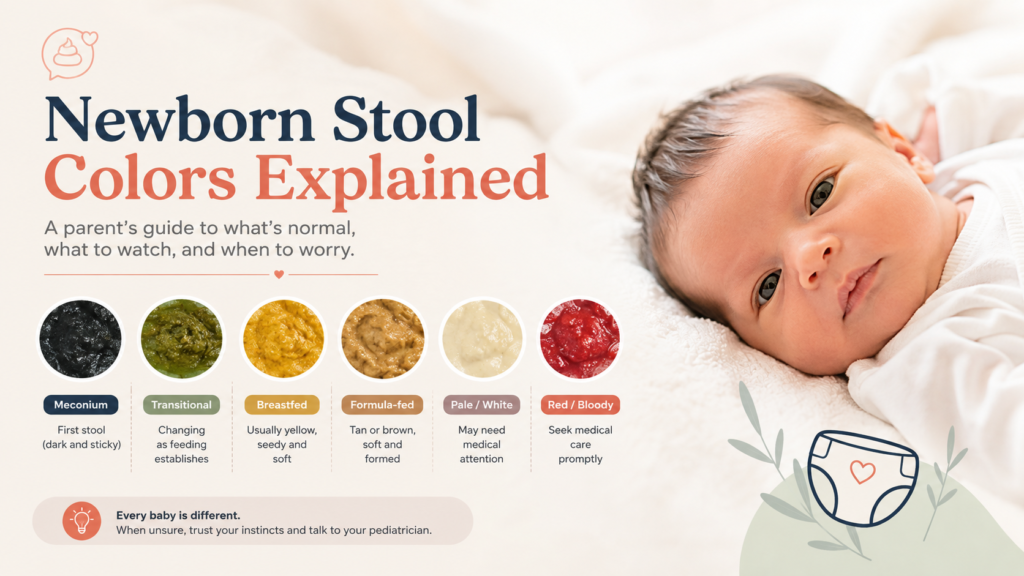
Let’s start at the very beginning: the first 24 to 48 hours of life. During this time, your baby will pass their first stool, known as meconium. It is going to look thick, highly sticky, and dark green to black. This is perfectly normal as it clears out substances your baby swallowed before birth. It also has virtually no odor because your baby’s gut doesn’t have active bacterial colonization yet
Let’s start at the very beginning: the first 24 to 48 hours of life. During this time, your baby will pass their first stool, known as meconium. It is going to look thick, highly sticky, and dark green to black. This is perfectly normal as it clears out substances your baby swallowed before birth. It also has virtually no odor because your baby’s gut doesn’t have active bacterial colonization yet
Stool Count: Expect 1 to 2 stools during this period.
Days 3 – 4 (Transitional)
By around the third or fourth day, as feeding gets established, you will notice a transition. The stool will lose its stickiness and shift to a greenish-brown or greenish-yellow color
Stool Count: Expect 2 – 3 stool per day
Day 5+ (Established)
Once you are past the first week, your baby’s stool will permanently change based on what they are eating. There is a big difference between the diapers of a breastfed baby and a formula-fed baby.
Exclusive breastfeeding
If you are exclusively breastfeeding:
What it looks like: Your baby’s stool will likely be mustard-yellow, loose, and seedy.
• Those little “seeds” are actually undigested milk fat and protein complexes, which are entirely normal for thriving breastfed babies.
• The smell is generally mild and sweet.
Stool Count: Frequency varies widely; young breastfed babies often poop after almost every feed. However, as they grow, their digestion matures, and they might slow down to pooping just once every three to five days. Some breastfed babies pass stool just once a week. That is perfectly fine as long as the stool remains soft and your baby is nursing well and gaining weight
Exclusively formula-feeding
If you are exclusively formula-feeding: • Your baby’s stool will be thicker, with a pasty or peanut-butter consistency.
What it looks like: The color will typically range from tan-yellow to pale brown or greenish-brown.
• Because most commercial formulas are fortified with iron, the stool might even take on a dark green hue, which is entirely harmless.
Stool Count: Formula-fed babies usually poop one to four times daily. They rarely exceed two days without a bowel movement.
The Safe Zone: Normal Newborn Colours
Once your baby’s system has cleared the meconium and settled into a regular feeding routine, you can generally expect to see these colors in the diaper.
🖤 Tar Black or Green-Black (Meconium)
What it looks like: Thick, sticky, and resembling motor oil or tar. It is notoriously difficult to wipe off.
The Story: This is meconium. It is made of amniotic fluid, mucus, skin cells, and other bits your baby swallowed while in the womb.
The Verdict: Perfectly normal for the first 24 to 48 hours. It is a great sign that the bowels are open and functioning. If you are still seeing pure meconium on day 4 or 5, let your healthcare provider know so they can verify feeding is going smoothly.
💚 Army Green to Green-Brown (Transitional Poop)
What it looks like: A lighter, looser green or greenish-brown, often less sticky than meconium.
The Story: This is transitional stool. It is a mix of the last remnants of meconium and your baby’s very first digestions of breastmilk or formula.
The Verdict: Normal. You will typically see this around days 3 and 4 as a transition to their settled diet.
💛 Mustard Yellow (The Breastmilk Standard)
What it looks like: Bright yellow, mustard yellow, or occasionally slightly golden-green. The texture is loose, sometimes watery, and often features tiny, white, seed-like flecks.
The Story: This is the classic stool of a exclusively breastfed baby. The “seeds” are simply unabsorbed milk fat and protein fragments, which is completely expected.
The Verdict: Normal. It often has a surprisingly mild, slightly sweet smell.
🤎 Tan, Yellow-Brown, or Greenish-Brown (The Formula Standard)
What it looks like: Pale yellow, tan, or a dull greenish-brown with a consistency closer to peanut butter or hummus.
The Story: Formula is processed slightly differently by the gut than breastmilk, leading to a bulkier, firmer, and more uniform stool.
The Verdict: Normal. It will generally have a more distinct, pungent odor than breastmilk stool, and babies consuming formula typically pass fewer stools per day.
The Variations: Mostly Normal (But Worth Watching)
🟢 Bright Forest Green
What it looks like: A vibrant, dark green, sometimes frothy or containing mucus.
The Story: Iron supplements or iron-fortified formula can naturally turn stool a deep green. In breastfed infants, a sudden shift to bright green, frothy stools can sometimes point to a “foremilk/hindmilk imbalance” (meaning the baby is getting a high volume of the watery, sugar-rich milk at the start of a feed, which moves through the gut very quickly). Occasionally, it can indicate a mild sensitivity to something in the maternal diet.
The Verdict: Usually fine. If your baby is happy, gaining weight, and has plenty of wet diapers, there is no need to worry. If it persists for days and is accompanied by fussiness or spitting up, check in with your paediatrician.
🚨 The Red Flags: When to Call the Doctor
While the newborn gut can produce a fascinating array of shades, there are three distinct colors that mean it is time to contact your healthcare provider.
⚪ White, Grey, or Pale Clay-Color
Why it matters: Stool gets its typical yellow, brown, or green coloring from bile, a digestive fluid produced by the liver. If the stool is completely pale, white, or chalky grey, it suggests that bile is not reaching the intestines. This can be an early sign of a rare but serious liver or gallbladder issue, such as biliary atresia.
Action: Call your pediatrician immediately if you see a completely pale or white diaper.
🔴 Red or Bloody Stool
Why it matters: Seeing red can be terrifying, but context is key. Small streaks of blood in a firm stool can mean a tiny tear in the anal skin from straining. In loose stools, it might indicate a cow’s milk protein allergy or a temporary gastrointestinal irritation. Occasionally, it is just swallowed blood from a cracked, bleeding nipple during breastfeeding.
Action: Have it checked out. Save the diaper or take a clear photo under good lighting so your doctor can evaluate the amount and pattern of the blood.
⬛ Deep Black (After Week One)
Why it matters: While black is expected in the first few days of life, a return to true, dark black, tarry stools later in the newborn period can indicate old blood traveling through the upper digestive tract.
Action: Contact your doctor to rule out any upper GI irritation.
The Golden Rule of Newborn Diapers: Consistency and behavior often matter more than the exact shade of yellow or green. If your baby is feeding eagerly, wetting at least six diapers a day, and seems generally comfortable, their digestive system is likely doing beautifully. When in doubt, trust your gut, snap a quick photo of the diaper under clear light, and show it to your pediatrician for reassurance
The Struggles: Grunting, Straining, and True Constipation
Now, let’s talk about something that causes a lot of anxiety for new parents: the straining. You might see your baby dramatically grunting, screaming, turning red or purple in the face, and pulling their legs up.
It is incredibly common for babies to grunt, get red-faced, and tighten their muscles when pooping. You might immediately think, “My baby is constipated!” But here is the secret: if the stool is soft when it finally comes out, this is not constipation
This is a benign, functional condition called infant dyschezia. It happens because your baby’s neuromuscular pathways are immature
They have not yet learned how to coordinate increasing pressure in their tummy while simultaneously relaxing their pelvic floor muscles
They are also trying to poop while lying flat on their back, without the help of gravity.
Infant dyschezia resolves spontaneously as your baby grows.
Please, strongly avoid using rectal thermometers, suppositories, or manual stimulation to “help” them poop. These invasive measures can actually interfere with your baby’s natural ability to learn pelvic floor coordination
So, what does true constipation look like?
True neonatal constipation involves passing hard, dry, pebble-like or pellet-like stools.
These hard stools cause pain, distress, or even tiny tears around the anus during passing.
f your baby is formula-fed and constipated, it might be due to improper formula preparation, like adding too little water
Always contact your doctor to discuss hard, painful stools
Conclusion: Trust Your Instincts
I know looking out for all of these signs can feel overwhelming. The main takeaway is that baby poop comes in a wide variety of normal textures and colors, from mustard yellow to peanut butter tan, and even iron-fortified green. It is completely okay if your breastfed baby goes several days without popping, as long as they are comfortable and the stool is soft. It is completely okay if they grunt and turn red while they are learning how their bodies work. But when you are calling your doctor about a concern, be ready to describe the color, texture, size, and how often your baby passes stool. The more details you provide, the better.
Remember, you are doing a great job. When in doubt, trust your parental instincts and reach out to your pediatrician